
Fire Ants vs. Tawny Crazy Ants: Harris County Identification & Control

Fire ants build distinct dirt mounds in lawns and deliver painful venomous stings, whereas tawny crazy ants do not build mounds, move in rapid erratic zig-zags, form massive super-colonies of millions, and invade electrical equipment, causing costly AC and breaker short circuits.
Harris County Ground Zero: Identification & Anatomy
In 2002, local pest management professional Tom Rasberry discovered an unfamiliar, hyper-aggressive ant species infesting industrial facilities and residential neighborhoods in Pasadena and Pearland. Initially dubbed the 'Rasberry crazy ant,' taxonomists later identified the invader as the tawny crazy ant (Nylanderia fulva), native to South America.
Over the past two decades, tawny crazy ants have spread aggressively across Harris and Montgomery counties, overwhelming local ecosystems and frustrating homeowners who mistake them for common red imported fire ants (Solenopsis invicta). Distinguishing between the two species is crucial because the chemicals that wipe out fire ants have virtually zero effect on crazy ants:
- Movement Dynamics: Fire ants march in disciplined, orderly scent trails along sidewalks and fence lines. Tawny crazy ants move with frantic, erratic, zig-zagging velocity, scurrying unpredictably with no discernable trail pattern.
- Physical Anatomy & Color: Fire ants are reddish-brown to dark blackish-red with two distinct nodes (petioles) between thorax and abdomen, and a visible stinger at the tip of the gaster. Tawny crazy ants are uniform reddish-brown, slightly smaller (1/8 inch), have only one petiole node, are covered in stiff reddish hairs, and lack a stinger.
- Stinging vs. Biting: Fire ants anchor with their mandibles and inject an alkaloid venom (solenopsin) with their stinger, producing burning pustules that itch for a week. Crazy ants do not possess a stinger; they bite with their jaws and spray an acid mist (formic acid) through a specialized specialized nozzle called an acidopore.
Mound Builders vs. The Super-Colony Matrix
The fundamental biological difference lies in nesting behavior and social architecture:
Red imported fire ants are territorial mound builders. A typical single-queen or multi-queen fire ant colony constructs a dome-shaped earthen mound up to 18 inches high to thermoregulate their brood. Because neighboring fire ant colonies fight violently over territory, yard populations naturally cap at 20 to 50 mounds per acre.
Tawny crazy ants, by contrast, do not construct mounds. They form interconnected 'super-colonies' containing dozens or hundreds of fertile, egg-laying queens cooperating harmoniously across vast continuous territories. Instead of digging mounds, millions of crazy ants nest under landscape mulch, flagstone pavers, concrete expansion joints, decaying logs, and tree bark. When populations peak in late summer, millions of ants form living carpets that cover entire lawns, sidewalks, and home foundations.
Need Immediate Guidance for Your Home?
Our local Humble coordination team is ready to answer questions and schedule on-site evaluations.
The Threat to Home Electrical Systems
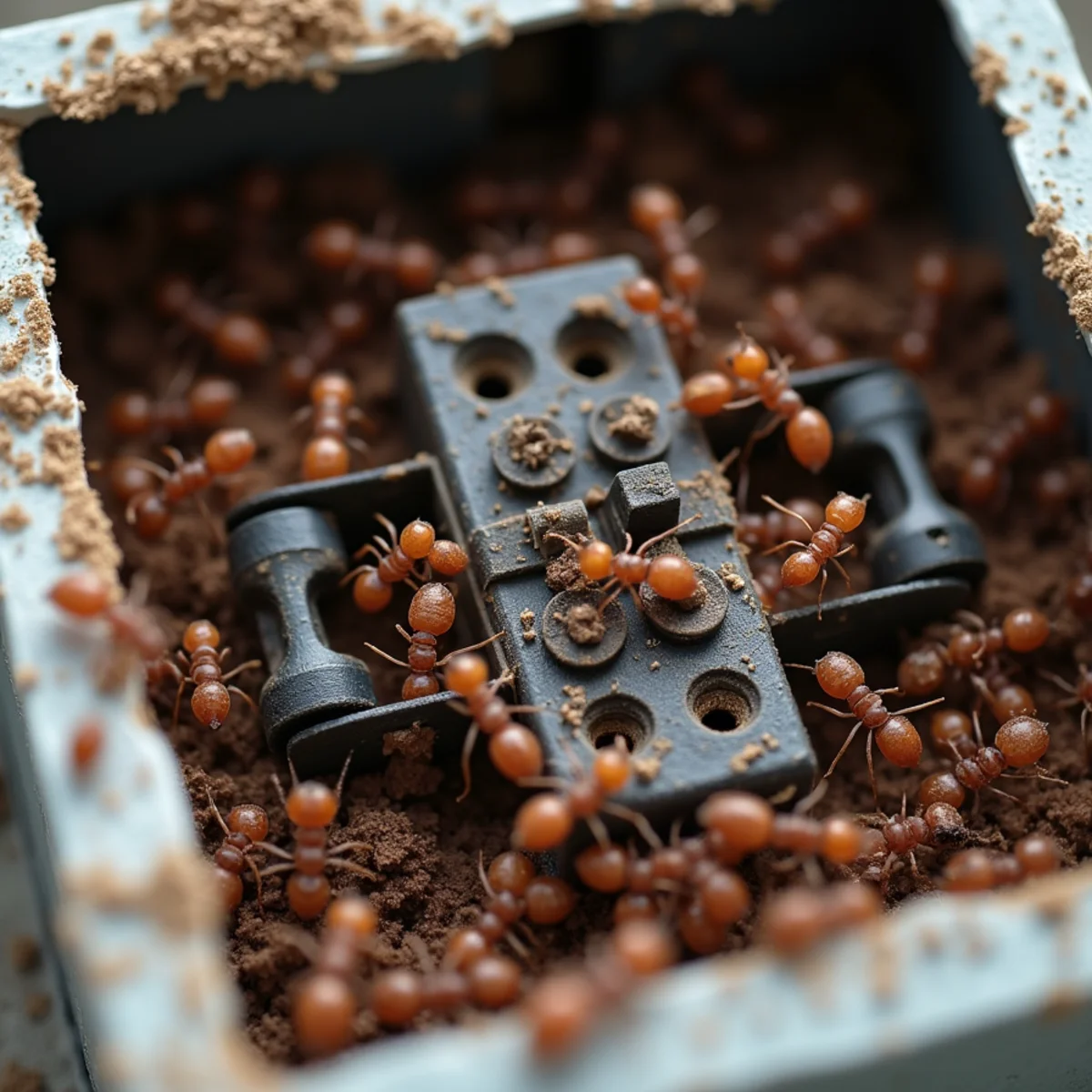
Beyond ecological nuisance, tawny crazy ants present a severe infrastructure hazard unique among Texas insects: they are strongly attracted to electromagnetic fields inside residential electrical equipment.
In communities like Humble, Kingwood, and Atascocita, crazy ants frequently colonize exterior air conditioning condenser units, swimming pool pump timer relays, security gate control boxes, and main electrical breaker panels. When a foraging ant explores the high-voltage contactor switch points of an AC condenser, its body bridges the electric contacts, causing electrocution.
Upon death, the ant curls its abdomen and releases an alarm pheromone that recruits thousands of nearby nestmates to the scene. Within hours, thousands of dead ants pile up between electrical contact points, creating an insulative barrier or catastrophic short-circuit that burns out expensive AC relays and compressors in the dead heat of July.
Chemical Warfare: Why Crazy Ants Displace Native Fire Ants
For decades, red imported fire ants reigned as the apex insect predator in Texas yards. However, where tawny crazy ants invade, fire ants are completely eradicated within two to three seasons.
Biologists at the University of Texas discovered that tawny crazy ants possess a unique biochemical defense mechanism. When stung by fire ants during territorial skirmishes, crazy ants immediately secrete formic acid from their acidopore, curve their bodies, and rub the acid over their exoskeletons. This acid bath completely neutralizes and detoxifies the fire ant's venom.
Combined with their overwhelming numerical superiority—often outnumbering fire ants by 100 to 1—tawny crazy ants quickly wipe out fire ant colonies, displacing native birds, lizards, and beneficial pollinators across entire neighborhoods.
Why Store-Bought Ant Sprays Fail Against Crazy Ants

Homeowners routinely spend hundreds of dollars on retail granular ant baits (like Amdro) and pyrethroid spray cans, only to watch crazy ant populations multiply. Standard DIY methods fail due to distinct biological barriers:
Granular Bait Rejection: Standard fire ant baits use defatted soybean oil on a corn grit carrier, which appeals specifically to lipid-loving fire ants. Tawny crazy ants prefer liquid carbohydrates and proteins; they routinely ignore standard retail fire ant baits completely.
The Repellent Spray Paradox: Spraying over-the-counter pyrethroids around the foundation acts as a chemical repellent. It kills a few thousand surface workers (a drop in the ocean of a 5-million ant colony) and triggers a defensive response called 'budding,' where the multiple queens split up and disperse throughout the attic, walls, and landscape, dramatically widening the infestation.
Professional Eradication Protocols: Eliminating crazy ants requires prescription-grade non-repellent liquid chemistry (such as Termidor SC or Taurus SC applied under strict TDA perimeter guidelines) combined with sweet liquid carbohydrate baits containing slow-acting active ingredients like indoxacarb or dinotefuran. Workers walk through the non-repellent barrier without detecting it, carrying the chemistry deep into satellite nests to collapse the reproductive queens.